

From RPA to Autonomous Agents: What’s Next in Workflow Automation

Automation has always been about helping enterprises do more with less. From the early days of Robotic Process Automation (RPA), which streamlined repetitive, rule-based tasks, to today’s emerging AI-driven autonomous agents, the journey reflects how businesses constantly seek to balance efficiency, scalability, and adaptability. While RPA delivered cost savings and compliance benefits, it is increasingly hitting its limits in the face of modern enterprise complexity. The real breakthrough now lies in moving toward autonomy, not just automation.
We are here to unpack the transition from RPA to autonomous agents in a clear and humanized way- exploring architectures, enterprise use cases, benefits, and the strategic considerations business leaders need to prepare for the future.
RPA: A Necessary Starting Point
For most enterprises, RPA was the logical first step in Automation. Bots were designed to replicate simple human actions such as logging into systems, extracting data, copying and pasting fields, and generating reports.
How RPA Fits into Enterprise Systems

Architecture: RPA operates on scripts and predefined rules. Bots operate through front-end interfaces, making them vulnerable when these interfaces are updated.
Data Dependency: Works best with clean, structured data like invoices, spreadsheets, or ERP fields.
Governance: Enterprises often manage hundreds of bots, requiring oversight, updates, and maintenance.
Kathryn Murphy
Enterprise Value Delivered
Finance: Automating reconciliations, invoice processing, and payroll.
Customer Service: Transferring data between CRM and ticketing tools.
Operations & HR: Migrating legacy data, generating compliance reports, automating onboarding paperwork.
The Shortcomings
- RPA doesn’t scale gracefully: adding new bots means adding new maintenance overhead.
- It lacks judgment: RPA cannot interpret unstructured inputs like emails or contracts.
- It struggles with change: regulatory shifts, new platforms, or system updates often break scripts.
RPA helped enterprises achieve efficiency, but it wasn’t built for adaptability. That’s where autonomous agents step in.

Autonomous Agents: Intelligence Meets Automation
Autonomous agents are AI-powered digital workers capable of perceiving, reasoning, and acting with context. Unlike RPA, which is task-driven, agents are goal-driven. They don’t just “follow orders” — they understand intent and adapt their approach in real time.
The Architecture of Autonomous Agents
Perception Layer: Agents process emails, documents, images, and voice using NLP, computer vision, and speech recognition.
Cognitive Layer: Machine learning and large language models (LLMs) help interpret context, detect patterns, and make decisions.
Action Layer: Agents execute tasks via APIs, system integrations, and even legacy applications.
Continuous Learning: Each action generates feedback, making agents smarter and more reliable over time.
Capabilities That Matter to Enterprises
Context Awareness: Agents don’t just complete a task — they understand the “why” behind it.
Adaptability: They thrive in environments where rules or processes evolve quickly.
Collaboration: Multiple agents can handle interconnected tasks across finance, HR, or supply chain.
Human-in-the-loop: When decisions carry risk, agents escalate intelligently to people.
Enterprise Use Cases: The Next Frontier
- Healthcare
RPA: Submitting claims or digitizing forms.
Agents: Reviewing patient history, scheduling based on urgency, validating insurance approvals, and updating EHRs — all autonomously.
- Financial Services
RPA: Generating compliance reports and reconciling accounts.
Agents: Detecting fraud in real-time, modeling risk exposure, delivering personalized customer advice.
- Supply Chain
RPA: Processing shipping labels and updating tracking logs.
Agents: Predicting inventory shortfalls, negotiating with suppliers, rerouting shipments when disruptions occur.
- Customer Experience
RPA: Pulling customer data into CRMs.
Agents: Offering multilingual, always-on conversational support that resolves queries end-to-end, with seamless handover when human input is needed.
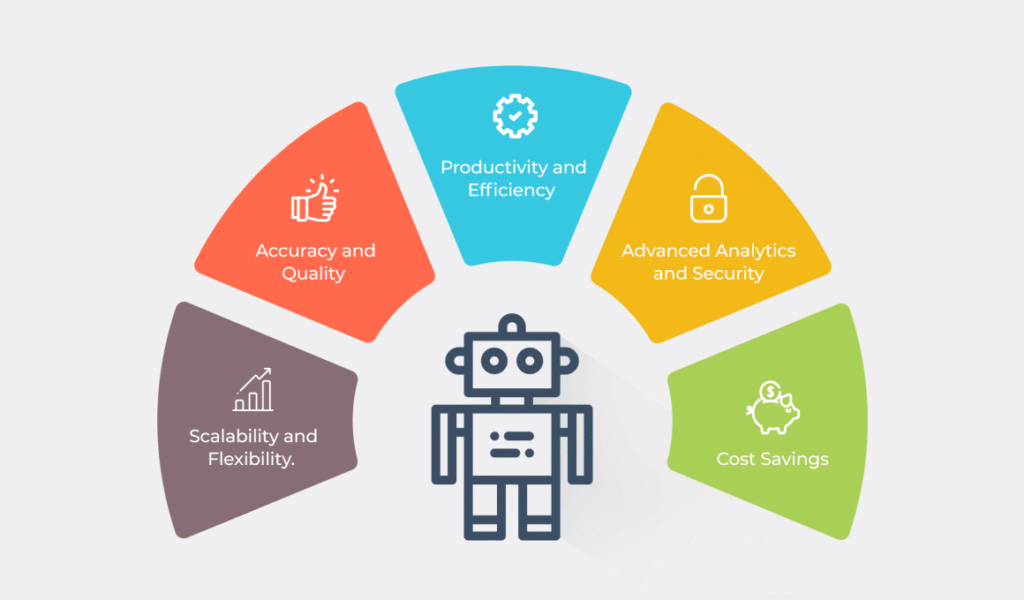
Why Enterprises like you should Care
- Scalability
RPA scales by adding more bots. Autonomous agents scale by learning — they become more capable without proportional increases in resources.
- Agility
Agents adapt in real time to regulatory changes, customer expectations, or system updates, keeping operations resilient.
- Cost Efficiency
While RPA saved 20–30% on repetitive tasks, autonomous agents enable 30–50% faster process cycles and 20–40% operational cost savings (Deloitte).
- Risk & Compliance
Agents monitor, detect anomalies, and enforce evolving compliance frameworks continuously.
- Workforce Transformation
By automating decision-heavy processes, agent free employees to focus on strategy, creativity, and innovation — not repetitive oversight.
Industry Outlook: The Rise of Agentic Ecosystems
This shift is accelerating. Gartner predicts that by 2026, 80% of enterprises will deploy autonomous agents in daily operations, compared to less than 10% today. Enterprises are moving toward agentic ecosystems — networks of specialized agents working in harmony.
Future Vision
In contract management, one agent reviews clauses, another identifies risks, and a third drafts negotiation strategies.
In healthcare, one agent handles intake, another updates patient records, while a third coordinates insurance approvals.
These systems behave like digital colleagues — collaborating, adapting, and scaling seamlessly.
Conclusion: From Efficiency to Intelligence
RPA was a critical milestone in the automation journey, but it belongs to a different era of enterprise needs. Static, rule-based bots are no longer enough in environments defined by complexity and rapid change.
Autonomous agents are the new standard. They don’t just execute; they think, learn, and collaborate, enabling enterprises to build workflows that are resilient, adaptive, and intelligent.
For forward-looking leaders, the real question is: Are we still relying on scripts, or are we preparing for intelligent systems that evolve with our business?
RPA solved yesterday’s efficiency problems. Autonomous agents are solving tomorrow’s complexity. Enterprises that embrace this shift today will lead in resilience, agility, and innovation. Be a part of the AI movement with Techno Union. Book a free Consultation Call with Techno Union to upskill your business game.