

Multi-Agent AI Orchestration: Australian Enterprise Guide 2026
The Australian enterprise landscape stands at an inflection point. While global tech giants race ahead with AI infrastructure, Australian businesses face a uniquely challenging environment—rising operational costs, an acute skills shortage, and an increasingly complex regulatory framework. Multi-agent AI orchestration isn’t just another technology trend; it’s rapidly becoming the strategic difference between enterprises that thrive and those that merely survive in 2026.
Why 2026 Marks the Turning Point for Australian Enterprises
Australian businesses can no longer afford to treat AI as a future consideration. Three converging forces are making multi-agent AI orchestration not just valuable, but essential for competitive survival.
The Skills Crisis Has Reached Breaking Point
Australia’s technology skills gap has evolved from a concern into a crisis. According to the Australian Computer Society’s 2024 Digital Pulse report, Australia faces a shortfall exceeding 186,000 technology workers, with AI and machine learning specialists among the most difficult positions to fill. Mid-tier Australian enterprises are losing talent to better-resourced international competitors offering remote roles with superior compensation packages.
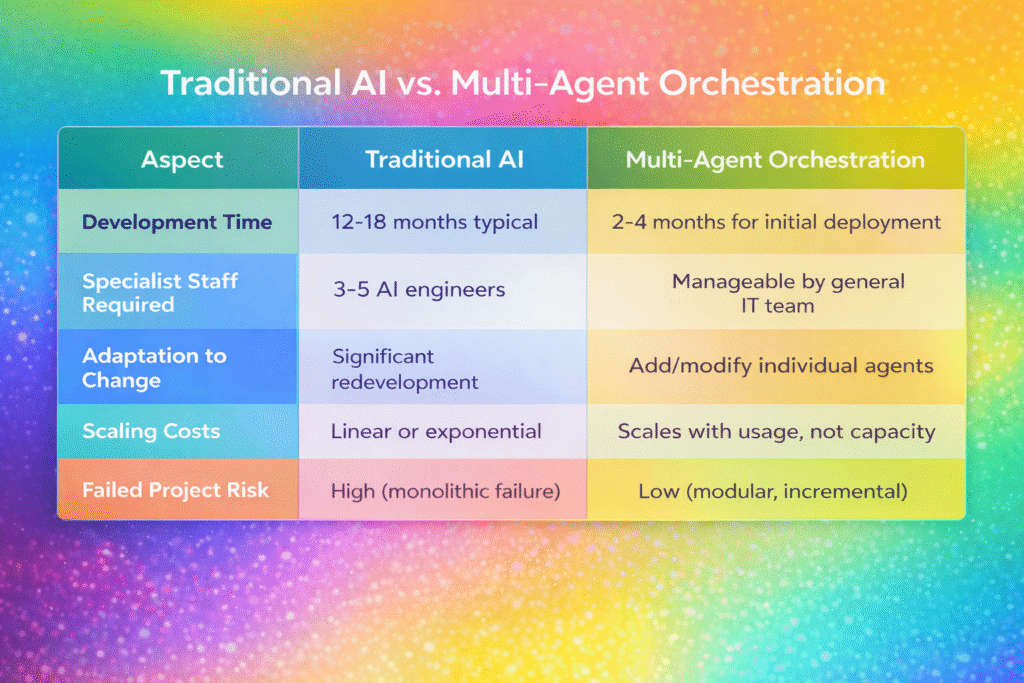
Multi-agent AI orchestration addresses this reality head-on. Rather than requiring teams of specialized AI engineers, these systems enable existing technical staff to deploy sophisticated AI capabilities through intuitive orchestration layers.
We recently helped a financial services firm in Melbourne deploy a multi-agent system that handles complex compliance workflows—work that would have traditionally required three full-time AI specialists. Their existing operations team now manages the entire system with minimal additional training, and they achieved full operational capability in just four months.
Operational Costs Are Squeezing Margins
Australian enterprises operate under unique cost pressures. Energy costs remain among the highest in the developed world, commercial real estate in major cities continues climbing, and the weaker Australian dollar makes international software licensing more expensive every year. These pressures create an environment where operational efficiency isn’t aspirational—it’s existential.
“Multi-agent orchestration delivered efficiency we couldn’t achieve through headcount or traditional automation. Our data analysis costs dropped 60% in the first year.”
— Operations Director, Perth Mining Services Company
Multi-agent orchestration delivers efficiency at scale. Unlike monolithic AI systems that require extensive custom development, orchestrated multi-agent frameworks allow businesses to deploy specialized agents for specific tasks, scaling computational resources only when needed.
A Perth-based mining services company we worked with reduced their data analysis costs by 60% by replacing their legacy analytics infrastructure with an orchestrated system of specialized agents that activate based on real-time demand rather than running continuously. Their ROI period? Just three months.
Compliance Complexity Demands Intelligent Automation
The regulatory environment facing Australian enterprises has never been more demanding. Privacy legislation continues evolving, industry-specific compliance requirements multiply, and the upcoming mandatory climate-related financial disclosures add another layer of complexity. Traditional compliance approaches—manual reviews, spreadsheet tracking, periodic audits—can’t keep pace with the volume and velocity of modern regulatory obligations.
Multi-agent AI systems excel in complex, rule-based environments. Individual agents can be configured to monitor specific regulatory domains, automatically flagging issues, generating required documentation, and maintaining audit trails without human intervention.
Understanding Multi-Agent AI Orchestration
At its core, multi-agent AI orchestration involves deploying multiple specialized AI agents that work collaboratively toward business objectives, coordinated by an orchestration layer that manages task allocation, information flow, and quality control.
Think of it like a well-run professional services firm. Rather than hiring generalists to handle everything, you employ specialists—legal experts, financial analysts, technical consultants—each excelling in their domain. A managing partner orchestrates these specialists, directing the right expertise to the right problems at the right time. Multi-agent AI systems work identically, but at digital speed and scale.
The Architecture That Powers Modern Orchestration
Effective multi-agent systems comprise three essential layers:
Specialized Agents form the foundation—each designed for specific tasks like data extraction, analysis, content generation, or decision support. These agents can be pre-built, customized, or purpose-built for your unique requirements.
The Orchestration Layer sits above these agents, managing workflow, handling errors, ensuring agents receive the information they need when they need it, and coordinating handoffs between agents for complex, multi-step processes.
The Integration Layer connects the entire system to existing enterprise infrastructure, from databases to business applications to external APIs, ensuring your multi-agent system enhances rather than replaces your current technology investments.
This architecture delivers flexibility impossible with monolithic AI systems. When business requirements change, you modify or add agents rather than rebuilding entire systems. When new AI capabilities emerge, you integrate them as new agents rather than migrating everything to new platforms.
The Australian Context: Unique Drivers and Barriers
Australian enterprises face distinct challenges that make multi-agent orchestration particularly valuable—but also encounter barriers that require thoughtful navigation.
Geographic Distribution and Remote Operations
Australia’s vast geography creates operational challenges unknown in more compact markets. Businesses regularly coordinate across time zones spanning their own continent, support remote mining operations hundreds of kilometers from major cities, and manage distributed teams across regional centers.
Multi-agent systems thrive in distributed environments. Agents can operate autonomously in remote locations, making real-time decisions without constant connectivity to central systems, then synchronizing when connections allow.
A good example is an agricultural enterprise that uses orchestrated agents at remote farm sites for autonomous irrigation decisions, pest monitoring, and equipment maintenance scheduling—operations that previously required constant human oversight or accepted significant inefficiency.
Data Sovereignty and Privacy Requirements
Australian privacy law, particularly under the Privacy Act and industry-specific regulations, creates strict requirements around data handling and storage. Many Australian enterprises, especially in healthcare, finance, and government sectors, face mandates requiring data remain within Australian jurisdiction.
Multi-agent architectures naturally accommodate these requirements. Sensitive data processing can be delegated to agents deployed on Australian infrastructure, while less sensitive operations leverage global cloud resources for cost efficiency.
The Local Talent Pool Challenge
While Australia produces excellent technology graduates, the domestic talent pool cannot meet current demand. International recruitment faces its own challenges—visa processing times, geographic isolation, and compensation expectations shaped by American tech salaries.
Multi-agent orchestration reduces dependence on scarce specialist talent. Systems can be deployed and managed by developers with general technical skills, supported by pre-built agent frameworks and low-code orchestration platforms.
Kathryn Murphy
Strategic Implementation for Australian Enterprises
Successful multi-agent orchestration requires more than technical deployment. The Australian enterprises we’ve worked with who see the strongest returns follow specific strategic patterns.
Start With High-Volume, Rule-Rich Processes
The strongest initial use cases combine high transaction volumes with clear business rules. Financial reconciliation, compliance monitoring, customer inquiry routing, and data quality management all fit this profile. These processes deliver measurable ROI quickly while building organizational capability and confidence.
We helped a Sydney-based not-for-profit organisation (Business NSW) begin their orchestration journey with document processing—a process involving thousands of daily documents, clear classification rules, and significant manual effort. Six months after deployment, their multi-agent system handles 85% of incoming documents automatically, freeing adjusters to focus on complex cases requiring human judgment.
Their results:
- 85% automation rate for standard documents
- 70% reduction in processing time
- 40% decrease in classification errors
- AU$500K annual labor cost savings
Build for Integration, Not Replacement
The most successful implementations treat multi-agent systems as augmentation rather than wholesale replacement. Agents handle routine tasks, data preparation, initial analysis, and standard decisions, while humans focus on exceptions, strategy, relationship management, and complex judgment calls.
This approach also eases organizational change management. Staff view agents as tools that eliminate tedious work rather than threats to employment.
Prioritize Governance From Day One
Multi-agent systems require robust governance frameworks. Who approves new agents? How are agent decisions audited? What safeguards prevent agents from making errors that cascade through interconnected systems?
These questions must be addressed before deployment, not after problems emerge.
Essential governance questions to answer:
- What approval process governs new agent deployment?
- How are agent decisions logged and auditable?
- What human oversight applies to high-stakes decisions?
- How do we ensure agents align with regulatory requirements?
- What monitoring detects agent performance degradation?
Leading Australian enterprises we advise establish AI governance committees that include technical leaders, business stakeholders, legal counsel, and risk management. These committees define acceptable use cases, review agent deployment proposals, monitor system performance, and ensure alignment with broader business strategy and regulatory requirements.
Invest in Orchestration Platforms, Not Custom Development
Building multi-agent systems from scratch requires expertise most Australian enterprises lack. Mature orchestration platforms provide pre-built agent frameworks, workflow designers, integration connectors, and monitoring dashboards that dramatically reduce development time and ongoing maintenance burden.
We recently helped a Sydney manufacturing company evaluate building custom versus using an orchestration platform. Custom development quoted at 18 months and AU$2.3M. The platform approach we recommended suggested comparable functionality in four months at one-third the cost, with significantly lower ongoing maintenance requirements.
The difference? Platform-based approaches leverage existing frameworks, proven integrations, and community-developed agents rather than building everything from scratch.
Navigating the Vendor Landscape
The multi-agent orchestration market is maturing rapidly, but selecting the right platform requires careful evaluation of capabilities, support, and local presence.
Global Platforms With Australian Support
Major platforms offer sophisticated capabilities and extensive documentation, but Australian enterprises should verify local support availability. Time zone differences can create frustrating delays when issues arise.
We guide clients toward platforms with Australian support teams, local implementation partners, and customer references from Australian enterprises. The difference in deployment success rates is significant—our clients using platforms with strong Australian presence achieve production readiness 40% faster on average.
Open Source Versus Commercial Solutions
Open source orchestration frameworks offer flexibility and avoid vendor lock-in but require significant internal technical capability to deploy and maintain. Commercial platforms provide polished interfaces, integrated support, and regular updates but create ongoing licensing costs and potential dependency.
Our recommendation? Most Australian enterprises find hybrid approaches most effective—commercial platforms for production systems requiring reliability and support, open source for experimentation and specialized use cases where customization matters more than polish.
Data Residency and Sovereignty
For enterprises handling sensitive data, verify where orchestration platforms store system data, logs, and agent configurations. Some platforms offer Australian data center deployment; others operate entirely from international infrastructure.
This distinction carries legal, performance, and risk implications that vary by industry and use case. We help clients navigate these requirements during platform selection to avoid costly surprises later.
Right-Sizing Your Multi-Agent Investment
Understanding investment levels helps you plan appropriately and set realistic expectations:
Pilot Programs: AU$50K-150K (8-12 weeks)
- Single use case implementation
- Proof of concept with real data
- Initial team training
- ROI validation before broader deployment
- Best for: Testing viability, building internal buy-in
Departmental Deployment: AU$200K-500K (4-6 months)
- Multiple coordinated agents
- Integration with existing systems
- Comprehensive team training
- Governance framework establishment
- Best for: Scaling proven use cases across a business unit
Enterprise-Wide Orchestration: AU$750K+ (12+ months)
- Organization-wide agent ecosystem
- Advanced orchestration capabilities
- Full governance and monitoring infrastructure
- Cross-departmental integration
- Best for: Strategic transformation initiatives
Most Australian enterprises we work with start with pilot programs, validate ROI, then expand based on demonstrated value.
Why Australian Enterprises Partner With Specialists
Multi-agent AI orchestration sits at the intersection of emerging technology, business process optimization, and Australian regulatory compliance—a combination that requires specialized expertise.
Working with local implementation partners who understand both the technology and Australian compliance landscape provides:
Faster Time to Value — We’ve deployed dozens of multi-agent systems for Australian enterprises. You benefit from our experience navigating common pitfalls, platform selection, and integration challenges.
Local Regulatory Expertise — Australian privacy laws, industry-specific regulations, and data sovereignty requirements aren’t afterthoughts in our implementations—they’re built into our design process from day one.
Ongoing Optimization — Multi-agent systems improve over time. We provide the ongoing monitoring, tuning, and enhancement that transforms good implementations into exceptional ones.
Risk Mitigation — Our governance frameworks, testing protocols, and staged deployment approaches reduce the risk inherent in adopting emerging technology.
Team Enablement — We don’t just deploy systems—we transfer knowledge to your team, ensuring you can manage, modify, and extend your multi-agent infrastructure independently.
The Cost of Delay: What Waiting Means for Australian Enterprises
Every quarter delayed carries real costs that compound over time:
Competitors Build Data Advantages You Can’t Replicate
Multi-agent systems improve through use. Every transaction they process, every pattern they identify, every optimization they discover creates proprietary intelligence. Competitors deploying now will have 12-18 months of accumulated learning by mid-2027—a gap nearly impossible to close.
The Skills Gap Widens While Talent Becomes More Expensive
Australia’s AI talent shortage isn’t improving. Salaries for AI specialists increased 23% in 2024-2025. Every quarter you delay deployment through traditional hiring approaches, the cost escalates. Multi-agent orchestration lets you move forward with existing teams.
Manual Compliance Costs Compound as Regulations Multiply
New reporting requirements, evolving privacy legislation, and industry-specific compliance obligations aren’t slowing down. Manual compliance approaches scale linearly with regulatory complexity—costs double when requirements double. Orchestrated agents scale without proportional cost increases.
Operational Inefficiencies Erode Margins in an Already Tight Market
Australian enterprises face margin pressure from multiple directions—rising energy costs, increasing labor expenses, currency fluctuations affecting international software costs. Operational inefficiencies that were annoying in 2023 become existential in 2026.
The enterprises that will dominate 2027-2030 are making their orchestration decisions right now.
The 2026 Imperative: Lead the Transformation or Follow It
The window for Australian enterprises to build multi-agent AI capabilities from a position of strength rather than desperation is narrowing. Early adopters are establishing competitive advantages that compound over time—better data, more refined agents, deeper organizational capabilities, and stronger talent attraction.
The enterprises thriving in 2026 aren’t necessarily those with the largest AI budgets or most aggressive technology strategies. They’re the organizations that recognized multi-agent orchestration as a strategic imperative, started with focused use cases that delivered clear value, built capability progressively, and created cultures where humans and AI agents collaborate effectively.
The skills gap will widen further. Operational costs will continue rising. Regulatory complexity will intensify. The Australian enterprises that deploy orchestrated multi-agent AI systems in 2026 won’t just weather these challenges—they’ll transform them into competitive advantages that define the next decade of their success.
Ready to Explore Multi-Agent AI for Your Enterprise?
We help Australian businesses navigate multi-agent AI orchestration—from strategy through implementation to ongoing optimization:
✓ Complimentary Multi-Agent Readiness Assessment — Identify your highest-value use cases and receive a concrete implementation roadmap (typically completed in under 2 weeks)
✓ Proof-of-Concept Development — Validate ROI with real data before committing to full deployment
✓ Platform Selection Guidance — Navigate the vendor landscape with expert advice tailored to your requirements
✓ Full Orchestration Platform Deployment — End-to-end implementation with knowledge transfer to your team
✓ Governance Framework Development — Establish policies, monitoring, and controls that ensure responsible AI use
✓ Ongoing Optimization and Support — Continuous improvement that keeps your system performing at peak effectiveness
Schedule a strategic consultation to discuss your specific requirements and how multi-agent orchestration can address your challenges.
Frequently Asked Questions
What is multi-agent AI orchestration?
Multi-agent AI orchestration involves deploying multiple specialized AI agents that work collaboratively toward business objectives, coordinated by an orchestration layer. Unlike monolithic AI systems, multi-agent approaches allow businesses to deploy task-specific agents that can be independently updated, scaled, and optimized.
Why is 2026 critical for Australian enterprise adoption?
Three forces converge in 2026: Australia’s technology skills shortage exceeds 186,000 workers, operational costs continue rising, and regulatory complexity intensifies. Multi-agent orchestration addresses all three simultaneously. More critically, early adopters are building compounding advantages—waiting means playing catch-up with competitors who have 12-18 months of learning and optimization.
How much does multi-agent AI implementation cost?
Investment varies by scope: pilot programs typically run AU$50K-150K over 8-12 weeks, departmental deployments AU$200K-500K over 4-6 months, and enterprise-wide implementations AU$750K+ over 12+ months. Most Australian enterprises start with pilots, validate ROI, then expand based on demonstrated value.
Can our existing IT team manage multi-agent systems?
Yes. Modern orchestration platforms are designed for general technical teams, not AI specialists. We’ve successfully deployed systems managed by existing IT teams with no prior AI experience. The key is selecting appropriate platforms and ensuring proper training during implementation.
How long until we see ROI?
Our Australian enterprise clients typically see positive ROI within 3-6 months for well-selected use cases. The mining services company mentioned earlier achieved ROI in 3 months; the insurance company in 4 months. Timeframes depend on use case selection, implementation quality, and organizational readiness.
What about data sovereignty and Australian privacy requirements?
Multi-agent architectures naturally accommodate Australian data sovereignty requirements. Sensitive data processing can be delegated to agents deployed on Australian infrastructure, while less sensitive operations leverage global resources for cost efficiency. We build compliance into design from day one.